
• Skip to main content
Compass

Lisa Finks|Lourdes Arencibia|Carolyn Duris

Compass
  • Start Here

    • Buying a Home on Chicago’s North ShoreThe North Shore buyer’s overview
    • Plan My Home SearchA short questionnaire to plan your search
    • The Insider’s Guide to the North ShoreThe towns, the housing and the process
    • North Shore Town QuizWhich North Shore town is your real estate soulmate?

    Find Homes

    • Coming Soon
    • Compass Private ExclusivesHow Compass private listings work
    • Search by Elementary School
    • Walk-to-Train

    Collections & Guides

    • New Construction Report + CollectionReport and current homes
    • Wilmette Lakefront Condo GuideCondo and co-op buildings on Sheridan Road

    Featured Guide

    North ShoreBuyer’s Guide

    The Insider’s Guide to the North Shore

    A buyer’s guide to the towns, the housing and the process.

    Get the Guide

  • Start Here

    • Selling a Home on Chicago’s North ShoreThe North Shore seller’s overview
    • Home ValuationFind out what your home is worth
    • North Shore Seller GuidePreparing your home to sell, room by room.

    Prepare & Position

    • Market Ready ConciergeThe current home-preparation program
    • Private ExclusivesA private-selling strategy, explained

    Seller Research

    • Best Time to Sell — North ShoreTown-by-town timing studies
    • Market InsightsLocal data and analysis

    Featured Resource

    North ShoreSeller Guide

    The North Shore Seller Guide

    Preparing your home to sell, room by room.

    Get the Guide

  • North Shore Communities

    All North Shore Communities

    • Wilmette
    • Winnetka
    • Kenilworth
    • Glencoe
    • Northfield
    • Glenview
    • Evanston
    • Northbrook

    Eight priority communities, not a boundary. Service extends throughout Chicago’s North Shore, the north suburbs, into the city and well beyond.

    Related Resources

    • North Shore Town Quiz
    • North Shore Schools & Attendance Boundary Guide
    • Search by Elementary School
    • Walk-to-Train
    • North Shore Preschool Guide

    Town Quiz

    Which North Shore Town Is Your Real Estate Soulmate?

    A short quiz for comparing the North Shore’s towns.

    Take the Quiz

  • Coming Soon
  • Market

    • Market Insights
    • Town Market Statistics
    • Best Time to Sell Studies

    Schools & Local Resources

    • North Shore Schools & Attendance Boundary Guide
    • North Shore Preschool Guide
    • Search by Elementary School
    • Walk-to-Train

    Guides

    • The Insider’s Guide to the North Shore
    • North Shore Seller Guide
    • Wilmette Lakefront Condo Guide
    • New Construction Report

    Stay Current

    • Monthly NewsletterThe North Shore, monthly.

    Subscribe

  • About

    • About Lisa, Lourdes & Carolyn

    Lisa, Lourdes & Carolyn

    • Lisa Finks
    • Lourdes Arencibia
    • Carolyn Duris

    Recognition

    • Recognition & Press

    Working Together

    Lisa Finks, Lourdes Arencibia and Carolyn Duris are independently licensed Compass agents who collaborate. Each represents her own clients.

  • Contact
  • Search Homes

Lisa Finks|Lourdes Arencibia|Carolyn Duris

Lisa Finks, Lourdes Arencibia and Carolyn Duris are independently licensed Compass agents who collaborate. Each represents her own clients.

What is Spray Foam? Why Should I Use It in My Next Remodel Project?

May 24, 2016 by Lisa Finks Leave a Comment

Ask the Expert: Greg Rekett, Sutherland Homes

Greg Rekett of Sutherland Home

Greg Rekett of Sutherland Homes

What is Spray Foam and Why Should You Use it in Your Next Remodel Project?

Spray polyurethane foam (SPF) is a spray-applied plastic that can form a continuous insulation and air sealing barrier on walls, roofs, around corners and other surfaces. SPF insulation is known to resist heat transfer extremely well and offers a highly effective solution in reducing unwanted air infiltration.
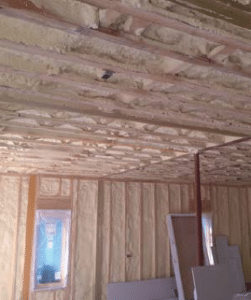
spray insulation

Spray Foam is an Energy Efficiency Solution

As much as 40% of a building’s energy is lost due to air infiltration. Gaps, holes and air leaks can make energy bills unnecessarily high. Spray foam performs as both insulation and an air barrier, closing gaps that let air escape and add dollars to monthly energy bills. As much as half of the energy used in a home goes to heating and cooling, according to EPA. Maintaining an optimal heating, ventilating, and air conditioning (HVAC) system can make your home more energy efficient. With spray foam, HVAC sizing can be reduced as much as 35%. Air leaks that can waste energy and drive up utility bills can be filled with spray foam.

Some common spots for air leaks that can be sealed with spray foam include the area behind knee walls, attic hatches, wiring holes, plumbing vents, open soffits, recessed lights, furnace flue or duct chaseways, basement rim joists, windows and doors. “Cool roofs” are designed to maintain a lower temperature than traditional roofs. They are light in color and reflect sunlight. Spray foam applied to the roof of a building can provide cool roof performance when topped with a protective, reflective coating. Spray foam roofs do not require metal fastening, eliminating the potential for thermal shorts or bridges that allow heat to enter.

spray insulation installation

Closed-Cell Spray Foam Can Improve Building Strength and Durability

Applying an SPF roofing system can improve a building’s strength. In fact, SPF roofs have effective lifespans that can?exceed 30 years. SPF can help create a strong bond to protect the roof and can eliminate water seepage through weak spots. It can also be applied in a sloped manner to allow water to easily drain off the roof.  The bond that SPF forms can increase a building’s resistance to wind uplift. During periods of high wind, a building with a spray foam roof generally experiences less

damage than a building without SPF. One prominent spray foam technical consultant notes that “when added to the inside of a structure, spray foam ‘glues’ the whole building together, enhancing overall wind and pressurization resistance.” SPF insulation adds strength and resilience. The Federal Emergency Management Agency (FEMA) has classified SPF insulation as highly resistant to floodwater damage, saying, “These materials can survive wetting and drying and may be successfully cleaned after a flood to render them free of most harmful pollutants.”

Spray foam prevents moisture and condensation throughout the building, helping prevent mold and mildew.  Applying closed-cell spray foam in the cavities of the walls increases durability of the wall system because of its ability to conform and adhere to the surface upon which it is sprayed. A wall with spray foam insulation is better able to maintain its shape under duress than a wall assembly without spray foam. Spray foam insulation provides these benefits:

  • Seamless protective layer
  • Eliminates air leakage through building envelope
  • Excellent adhesion to substrate
  • Fast application
  • Prevents thermal bridges
  • Reduces the cost of heating / cooling
  • Environmentally-friendly
  • Does not support mold growth
  • Healthier living
  • Significantly reduces energy consumption and investment in quality insulation
  • Sound insulation
  • Lightweight

While Spray Foam costs more than traditional insulation methods, that cost is easily made up within 5 to 7 years.  After that point, it will pay dividends forever more. . .

To contact Greg Rekett of Sutherland Builders with any questions or project needs, email him at:  gregr@sutherlandhomes.com.

Sutherland logo

Filed Under: Ask The Expert, Home construction

Reader Interactions

Leave a Reply Cancel reply

Your email address will not be published. Required fields are marked *

This site uses Akismet to reduce spam. Learn how your comment data is processed.

The North Shore, monthly.
Market updates, community news and the occasional exclusive — about once a month, and never more than you'd want.
Join Our Monthly Newsletter

Compass
568 Lincoln Avenue
Winnetka, Illinois 60093
Lisa Finks
847.778.0540
Lisa@LisaFinks.com
Lourdes Arencibia
773.793.6220
lourdes@welcomehomenorthshore.com
Carolyn Duris
847.334.1600
carolyn.duris@compass.com
Buying Selling Coming Soon Communities Market Insights Contact

Lisa Finks, Lourdes Arencibia and Carolyn Duris are independently licensed Compass agents who collaborate. Each represents her own clients.

© 2026 Compass. Compass is a licensed real estate broker and abides by Equal Housing Opportunity laws. Licensing & Disclosures · Privacy Policy

All material presented herein is intended for informational purposes only. Information is compiled from sources deemed reliable but is subject to errors, omissions, changes in price, condition, sale, or withdrawal without notice. This is not intended to solicit property already listed.

Square footage, lot size, room counts, taxes and school assignment come from the MLS, from public records or from a third-party measurement service. Verify anything you intend to rely on.

Nothing herein shall be construed as legal, accounting or other professional advice outside the realm of real estate brokerage.
